
Bedtime Stories for a Worried Mind: Helping Your Child Let Go of the Day's Worries
When little worries follow your child to bed, a gentle story can help them put the day down and drift off feeling safe. Here's how to use bedtime storytelling to ease a worried mind.
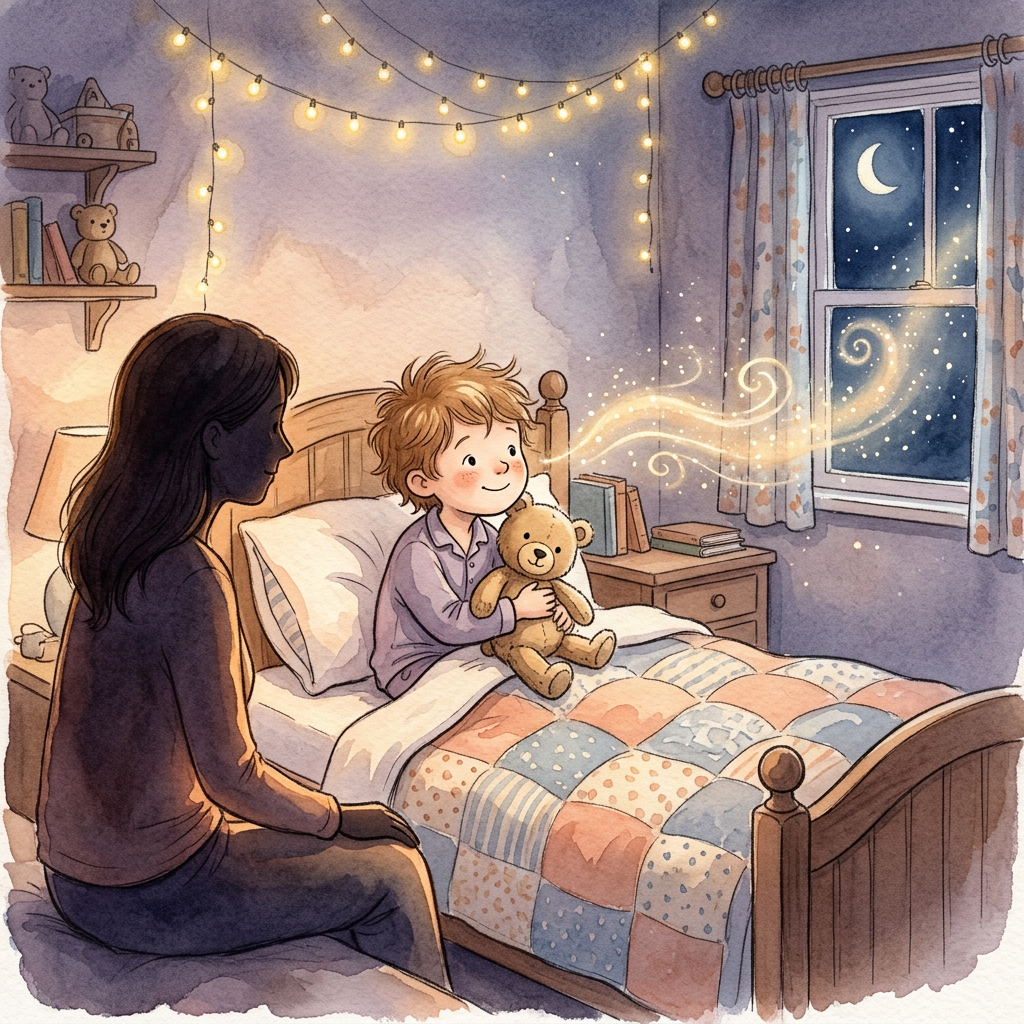
Some children go to bed with nothing on their minds but sleep. Others carry the whole day up the stairs with them — the wobble on the balance beam at PE, the friend who seemed a bit off at lunchtime, the thing they said that they're now not sure was funny after all. If you've ever tucked in a child who suddenly remembers, at the worst possible moment, that they're worried about something, you'll know how quickly a calm bedtime can unravel.
Worry at bedtime is enormously common, and it isn't a sign that something is wrong with your child or your routine. The mind quietens down for sleep by processing the day, and for a child who hasn't yet learned how to file worries away, that processing can spill out as tears, stalling tactics, or a sudden flood of "what if" questions right as the lights go off. The good news is that storytelling — something you're probably already doing most nights — is one of the gentlest and most effective tools for helping a worried mind settle.
Why stories work better than reassurance alone
It's tempting to respond to a worry with facts: "there's nothing under the bed," "your friend probably didn't even notice," "the dentist doesn't hurt." Sometimes that helps. But a young child's worries rarely live in the part of the brain that responds well to logic at half past seven in the evening. They live somewhere more emotional, and that's exactly the territory stories are built for.
A story lets a child see their own feeling reflected in a character who isn't them — a small fox who can't stop thinking about tomorrow, a little owl whose tummy goes fizzy when she's not sure what's wrong. Watching that character work through the worry, feel a bit braver, and find their way to sleep gives your child something reassurance alone can't: proof, in story form, that a worry can be felt and still lead somewhere calm.
A few ways to bring this into your routine
Name the worry gently, without dwelling on it. Before the story starts, a simple "Sounds like something's on your mind tonight" gives your child permission to say it out loud once, rather than replaying it in their head after the lights go off.
Let the story do the reassuring, not you. Rather than solving the worry directly, choose or tell a story where a character has a similar feeling and finds their own gentle way through it. Children often absorb comfort more easily when it arrives sideways, through a character, than when it's aimed straight at them.
Keep the ending soft and certain. A worried child benefits from knowing exactly how the story ends before they close their eyes — safe, warm, tucked up, everything all right. Save the twists and cliffhangers for daytime stories; bedtime is for endings that land gently.
Build in something to hold onto. A small, repeatable idea — "brave breaths," a favourite toy who "listens" to worries, a particular phrase the character uses — gives your child something to return to on nights when the worry creeps back in without a story attached.
Don't rush past the feeling. It can be tempting to skip straight to distraction when a child is anxious at bedtime, but naming the feeling first ("worried tummy," "busy brain") often gets to calm faster than trying to jolly them past it.
When a personalised story helps
Generic reassurance can feel a little distant to a child in the middle of a worry — but a story where they are the hero, facing something recognisably close to their own feeling, tends to land differently. This is where Wispalo can help. You tell us a little about your child — their name, their age, the things that light them up — and we generate a bedtime story built around them, with a "Feeling Worried" theme designed for exactly these evenings: a gentle, age-appropriate journey where your child's own character learns that a worry doesn't have to be faced alone, and that it's safe to let it go and drift off.
It only takes a couple of minutes to set up, and it's ready to read (or, with narration, to listen to) the same night — no waiting, no app to teach your child how to use, just a story that's theirs.
Worry at bedtime tends to soften with practice, patience, and the right kind of story at the right moment. If tonight is one of those nights, Wispalo is there to help you find it.
Try a story tonight
Wispalo turns your child into the hero of their own bedtime story in seconds.
Create a free story