
Going to the Doctor: A Bedtime Story to Settle Appointment Nerves
Got a doctor's appointment coming up and a worried little one? Here's how a calm bedtime story the night before can turn dread into curiosity — plus what to say (and what to skip) on the night itself.
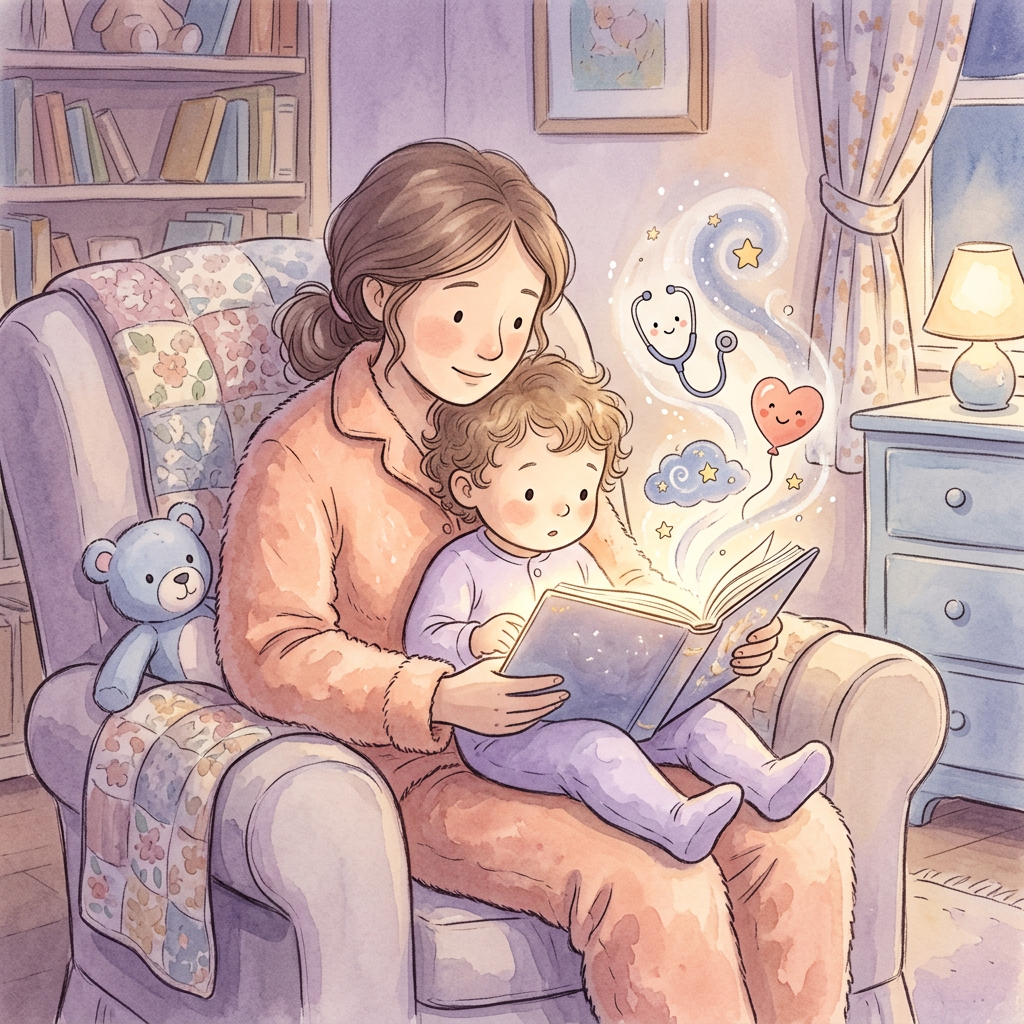
If you've got a doctor's appointment on the calendar and a child who's already asking "will it hurt?" on repeat, you're not alone. Doctor's visits are one of the most common sources of pre-appointment nerves for young children — even a routine check-up can feel enormous when you're small and don't really understand what's about to happen.
The good news is that one of the simplest tools for taking the edge off is one you probably already do every evening anyway: a bedtime story.
Why the night before matters so much
Children process big, unfamiliar events by rehearsing them — in play, in questions, and in the stories we tell them. A bedtime story the night before an appointment gives your child a low-pressure way to imagine what's coming, ask their questions in a safe space, and fall asleep with something gentler in their mind than "what if it hurts."
It also does something quietly powerful for the story's hero (your child, cast as the star of their own adventure): it puts them in control. In real life, a doctor's visit is something that happens to a child — they're told where to sit, what to do, when to say "ahh." In a story, they get to be the one who's brave, who asks the doctor questions, who decides how the day goes. That shift from passenger to protagonist is a big part of why storytelling works so well for pre-appointment nerves.
What actually helps (and what doesn't)
A few things tend to make the biggest difference, based on what pattern many parents and health professionals recommend:
Keep it honest, but gentle. Vague reassurances ("it'll be fine!") can backfire if something does feel a bit uncomfortable, like an injection or having their ears checked — children remember being told nothing would happen, and that dents trust for next time. A better approach is naming, calmly, one or two things that might happen ("the doctor might look in your ears with a special little torch"), without dwelling on anything scary.
Let them ask the odd questions. "Will the doctor have teeth?" "Can the doctor see inside my tummy?" These aren't a sign something's wrong — they're just how children make sense of the unknown. A bedtime story is a lovely place to let those questions surface naturally, in character, rather than fielding them in the surgery waiting room.
Give the story a friendly doctor character. In a story, the doctor can be warm, curious, and a little bit magical — someone who's genuinely pleased to meet your child, who explains things in their own words, who makes the whole visit feel like part of an adventure rather than something being done to them. That's a very different emotional starting point than walking into an appointment cold.
Avoid overdoing the reassurance. It can be tempting to spend the whole story saying "it's not scary, it's not scary" — but too much reassurance can actually signal to a child that there is something to be scared of. A lighter touch, where the visit is simply one part of a bigger, more interesting story, tends to land better.
Skip anything that dramatises the difficult parts. If your child does need an injection or a procedure that might be uncomfortable, this isn't the moment for a story that lingers on it. Keep that part brief and matter-of-fact, and let the story's warmth do the reassuring, rather than the plot.
A simple structure that works
If you're making up a story on the spot (no shame in the classic "bear who goes to see Dr. Owl" approach), a gentle shape to follow is: your child's character has a small worry about their appointment, they talk it through with someone they trust, they meet a kind doctor character who explains things simply, something goes a little differently than expected (a funny sticker chart, a favourite toy allowed to "help"), and the story ends with them feeling proud of themselves for being brave. Children love a story where they're the one who handles something well — it's a rehearsal for the real thing, dressed up as a bedtime adventure.
If your child still wakes up worried
It's worth saying plainly: one story won't erase every nerve, and that's completely normal. Some children need to hear a version of the same story two or three nights running before an appointment actually sinks in as "not scary." That repetition isn't a sign the story isn't working — repetition is often exactly what settles a worry for a young child. Let them ask for it again.
Making this easier on a tired evening
Coming up with a fresh, calm, well-pitched story every night — on top of everything else in a bedtime routine — is a lot to ask of any parent, especially the night before an appointment when you've got your own things to think about. This is exactly the kind of moment Wispalo was built for: tell it your child's name, age and interests, choose a life moment like "Going to the Doctor," and it weaves a personalised story with your child as the hero, ready to read together in a couple of minutes. Some parents like to add narration so they can listen along together, hands free, while winding down. If a doctor's visit is on the horizon in your house, it's worth giving it a try at wispalo.com.
Whatever you end up reading tonight, the biggest thing to remember is that the goal isn't to make your child feel nothing about the appointment — it's to help them feel like someone who can handle it. A calm story, told with warmth the night before, does a surprising amount of that heavy lifting.
Try a story tonight
Wispalo turns your child into the hero of their own bedtime story in seconds.
Create a free story