
Losing a First Tooth: A Bedtime Story to Settle the Wobbly-Tooth Worries
A wobbly tooth can mean an excited, anxious, or downright reluctant-to-sleep child. Here's how a short bedtime story can turn "will it hurt?" into "I can't wait!"
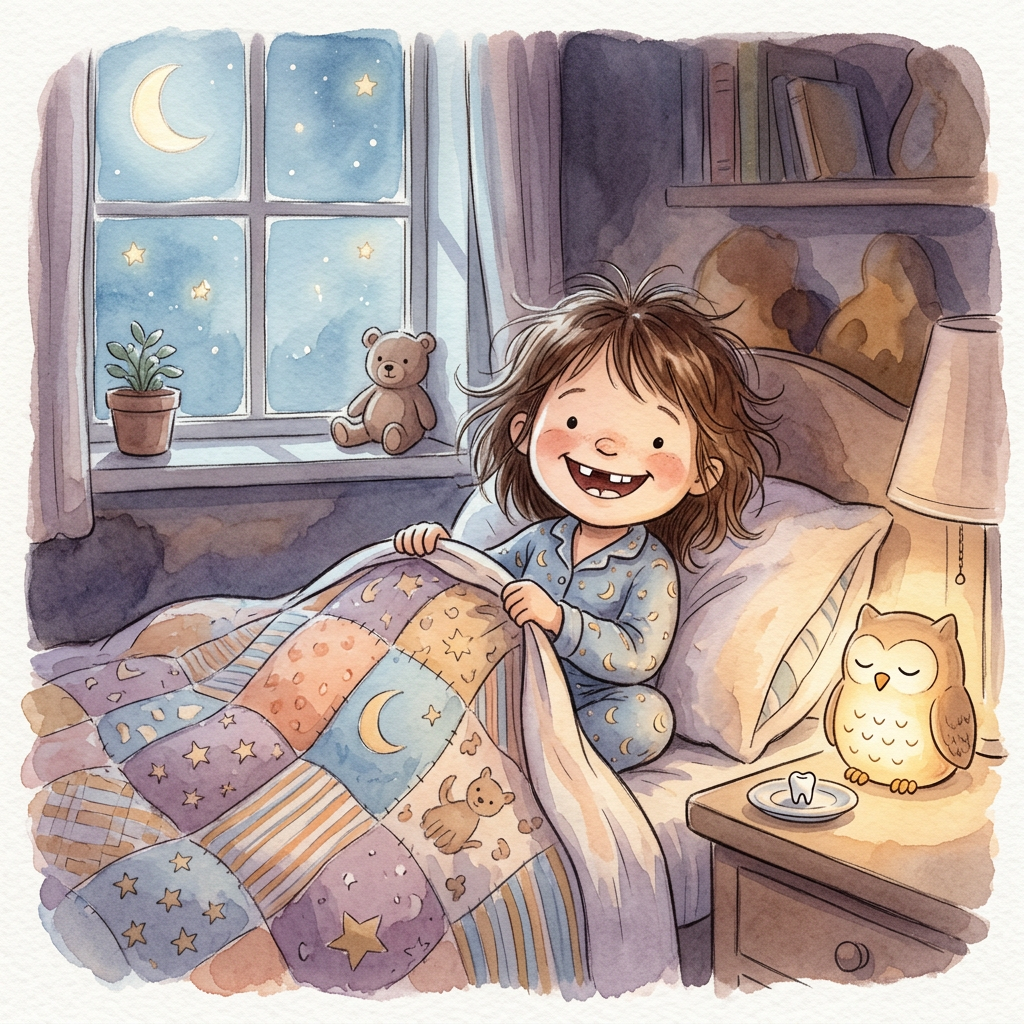
There's a particular kind of bedtime chaos that arrives with a wobbly tooth. One night it's an ordinary Tuesday. The next, your child is lying rigid under the duvet, tongue working away at a tiny loose peg, asking questions you don't quite have ready answers for. Will it hurt? What if it falls out while I'm asleep? What if I swallow it? Will the tooth fairy definitely come, and what if she doesn't find our house?
None of this is really about teeth. It's about the unfamiliar — a body doing something new and slightly alarming, at exactly the hour a child is meant to be winding down, not winding up. And it turns out one of the gentlest ways through it is one of the oldest tools parents have: a short story, told at bedtime, that puts the wobble in its proper place.
Why a loose tooth unsettles bedtime specifically
Most first teeth start wobbling around age five or six, right as children are becoming aware of their own bodies changing in ways they can't control — a theme that runs through a lot of early-years anxiety, not just teeth. Daytime, there's enough going on to distract from it. But bedtime strips all that away. Lying still in the dark is exactly when a small worry gets loud.
There's also a genuinely tricky logical knot in the middle of it: losing a tooth is framed as exciting and grown-up (a rite of passage, a visit from the tooth fairy, a coin under the pillow) while also being, undeniably, a bit of your own body coming out. Adults skip past that contradiction. Children sit right in the middle of it, and bedtime is when they finally have time to notice.
What actually helps, before the story
A few practical things make the conversation easier, story or no story:
Answer the mechanical questions honestly and simply. A first tooth wobbling out is not like an adult tooth being pulled — there's usually little to no pain, because the permanent tooth underneath has been gently pushing the baby tooth's root away for months already. Saying this plainly, without over-promising ("it definitely won't hurt at all, ever"), tends to land better than vague reassurance.
Give the worry somewhere to go. "What if I swallow it in my sleep?" has a real, calm answer: it happens sometimes, and it's completely harmless — it just passes through like food does. Naming the actual worst case, out loud, and showing it's survivable, usually does more good than changing the subject.
Let the excitement lead. Most children are genuinely thrilled about the tooth fairy, once the nerves settle — it's just that thrill and nerves can turn up in the same ten minutes, and small children haven't yet learned to hold both at once. Naming that ("I think you're a bit excited and a bit nervous, and that's allowed") often does a surprising amount of the calming work by itself.
Where a bedtime story earns its place
This is exactly the kind of worry that responds well to story rather than explanation. A five-year-old doesn't need a dental diagram; they need to hear about a character their own age going through the same wobble, the same "what if," and coming out the other side smiling a gap-toothed grin. Fiction lets a child rehearse the feeling from a safe distance — watching someone else be a little brave — before they have to be brave themselves.
It also helps to make the child the hero of it rather than a bystander. A story where your child is the one with the wobbly tooth, tucked into their own bed, in their own room, tends to land far more gently than a generic tale about someone else's tooth fairy visit. The specificity — their name, their pet, their favourite colour on the tooth-fairy's coat — is what turns "a story about teeth" into "my story."
This is the exact idea behind Wispalo. You tell it a little about your child — their name, age, and interests — and a couple of details about tonight's worry (a wobbly tooth, in this case), and it writes a short, gentle, fully personalised bedtime story with your child cast as the hero, complete with a warm cover illustration. If you'd rather not read aloud tonight, several stories can be narrated too, so you can simply lie down beside them and let the story do the settling. There's a free story to try first, so you can see whether it suits your bedtime before deciding it's for you.
A simple script, if you'd rather do it yourself tonight
If you don't have a story ready to hand, even a few improvised lines at bedtime can help: "Once there was a child who woke up one morning and felt something wobbly. At first they weren't sure if they liked it. But by bedtime, they'd decided it was actually rather exciting — because it meant they were growing, and because somewhere, a very small, very kind visitor was already getting ready for a very important, very quiet visit that night..."
You know your child best, so let them fill in the details as you go — what the tooth fairy looks like, what she does with all those tiny teeth, what colour her wings are. Handing them the pen, even for a made-up bedtime tale, gives them a small, safe sense of control over something that otherwise feels entirely out of their hands.
Whichever way you tell it, the aim is the same: to turn a strange, slightly wobbly night into one more small, proud step — and then, gently, into sleep.
Try a story tonight
Wispalo turns your child into the hero of their own bedtime story in seconds.
Create a free story