
Helping a Shy Child Make a New Friend: A Bedtime Story That Builds Confidence
Struggling to help a shy or nervous child make new friends? Here's a gentle bedtime routine — and a story approach — that helps children feel braver about reaching out.
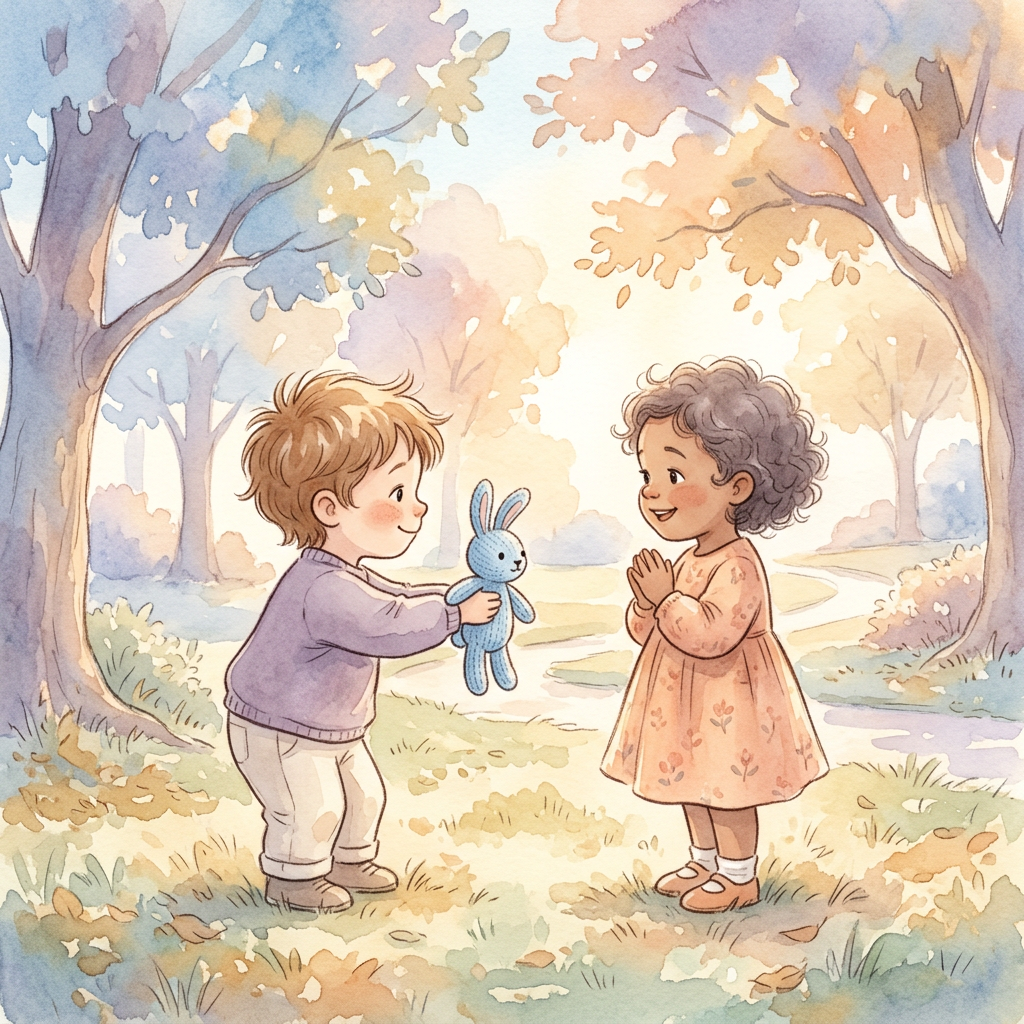
"I don't have anyone to play with." It's one of the hardest sentences a parent can hear at pick-up time, and it tends to surface again at bedtime, when the day finally has room to be talked about. Making a new friend — at a new school, after a house move, or simply in a class where the friendship groups already feel fixed — is one of the more quietly daunting things we ask children to do. For a shy or cautious child, the idea of walking up to someone new can feel every bit as big as it sounds.
The good news is that friendship, like most things children worry about, responds well to gentle rehearsal. And there's no gentler place to rehearse than in a story, last thing at night, with no pressure and no audience.
Why bedtime is the right moment for this
During the day, a child who's anxious about making friends is usually in problem-solving mode — trying to manage the actual situation in real time. There's rarely space to reflect. Bedtime is different. The lights are low, the day's over, and there's nothing left to get right. That's exactly the kind of calm, low-stakes environment where a child can hear an idea about bravery or connection without feeling like it's a lesson aimed squarely at them.
A story about a character who feels nervous meeting someone new — and finds their own small, believable way through it — lets a child sit with the feeling from a safe distance. They're not being told what to do. They're watching someone like them work it out, which tends to land far more gently than direct advice ever does.
What actually helps nervous children, according to child psychologists
A few things come up again and again in research and clinical guidance on childhood social anxiety and friendship-building:
Small, specific scripts beat vague encouragement. "Just go and say hello" is much harder for a shy child to act on than a concrete opening line they've already heard modelled — "I like your trainers, where did you get them?" or "Can I play too?" Stories are a brilliant place to plant these scripts, because the child hears exactly what a friendly opening sounds like, in context, without it being aimed at them.
Shared activity is easier than shared conversation. Children (and plenty of adults) find it far less intimidating to bond over doing something together — building, drawing, a game — than over open conversation. A story in which two characters connect through a shared activity, rather than a big heartfelt chat, models a far more achievable first step.
Normalising the wobble matters. Children often assume everyone else finds this easy and they're the only one who feels sick with nerves before saying hello. A character who admits to feeling exactly that — heart thudding, stomach fizzing, nearly turning back — and goes ahead anyway, does more for a child's confidence than a character who breezes in fearlessly. The bravery is in doing it despite the nerves, not in not having any.
Follow-through beats the opening line. The hardest part often isn't the first hello — it's what happens next, when there's an awkward pause or the other child doesn't respond quite as hoped. Stories that show a character navigating a slightly bumpy middle (not every attempt at friendship goes smoothly on the first try) are more useful than ones where it all works out instantly.
A simple bedtime routine to try
If your child has an event coming up where they'll need to make a new connection — a new class, a party where they won't know anyone, a new club — try this the night before:
- Ask gently, without pressure, whether they're looking forward to it or feeling nervous. Let them answer honestly; resist the urge to reassure too quickly.
- Read or tell a story where a character feels the same way and finds a small, doable way through it.
- Afterwards, ask one soft, open question — "What do you think you might say?" — rather than a test. There's no need for them to answer fully; the seed is often enough.
- Let the story do the rest. Children process far more than they show, and a familiar story often resurfaces in their own words days later, at a moment you'd never have predicted.
Where Wispalo fits in
This is exactly the kind of story Wispalo is built to create. Tell it a little about your child — their name, their age, what they're nervous about, even the names of any pets or family members you'd like woven in — and it will generate an original bedtime story, personalised to them, where they are the hero finding their own brave way to say hello. Each story comes with a cover illustration, and can be narrated aloud in a choice of gentle voices if you'd rather listen together than read.
There's no need to find the "right" existing book about making friends. You can shape a story exactly around what your child is facing this week, with their own name in the title and their own worries met with warmth rather than a lecture.
If a new friendship is on the horizon for your little one, give Wispalo a try tonight — it takes a couple of minutes, and it might just be the gentle nudge they need.
Try a story tonight
Wispalo turns your child into the hero of their own bedtime story in seconds.
Create a free story