
The Best Screen-Free Bedtime Routine for Kids (And Where Stories Fit In)
A calm, practical screen-free wind-down routine for bedtime — and why a short story at the very end makes all the difference.
Most parenting advice about screens at bedtime starts with a warning. This isn't going to be one of those. You already know a screen right before bed isn't ideal — the guilt about it is doing you no favours at half past seven when everyone is tired and a tablet is the fastest route to five minutes' peace. What actually helps is having something else ready to reach for that's just as easy, so the choice isn't "screen or struggle."
Here's a screen-free wind-down that real families actually manage to stick to, plus a few reasons a short bedtime story earns its place at the very end of it.
Why the last hour matters more than the whole day
You can't undo a chaotic afternoon, and you shouldn't try to. But the last 30 to 60 minutes before sleep has an outsized effect on how easily a child actually drops off, because it's when their nervous system either winds down or stays wound up. Bright screens are the obvious culprit — the blue light delays melatonin release, but just as importantly, fast-cut, stimulating content keeps a young brain alert exactly when you need it to slow down. The goal of a wind-down routine isn't to be virtuous. It's to work with your child's biology instead of against it.
A routine that survives real evenings
Forget the pristine four-step routines you see online. Here's a version built for evenings where you're also doing the washing-up, answering one more work message, and negotiating about pyjamas.
1. One transition cue, every night. This could be dimming the lights, closing the curtains, or a particular phrase ("right, it's cosy time"). Consistency matters far more than the specific cue — it's a signal to your child's brain that the day is closing, not a ritual you need to perform perfectly.
2. Bath or wash-up, if it fits. Warm water genuinely helps — it's not an old wives' tale. A drop in body temperature after a warm bath mimics the natural temperature dip that happens as we fall asleep. If a full bath doesn't fit every night, even a warm flannel wipe-down keeps the association.
3. Low-stimulation play, not screens. This is the bit that trips families up, because "no screens" can feel like "no options." It doesn't have to be elaborate — building a small tower, colouring, sorting a box of buttons, or just lying on the floor chatting about their day all do the job. The aim is quiet hands and a quiet room, not entertainment.
4. Teeth, toilet, tuck-in — the boring bit. Keep this part brisk and predictable. Children push back less against a routine that never changes than one that's negotiated fresh every night.
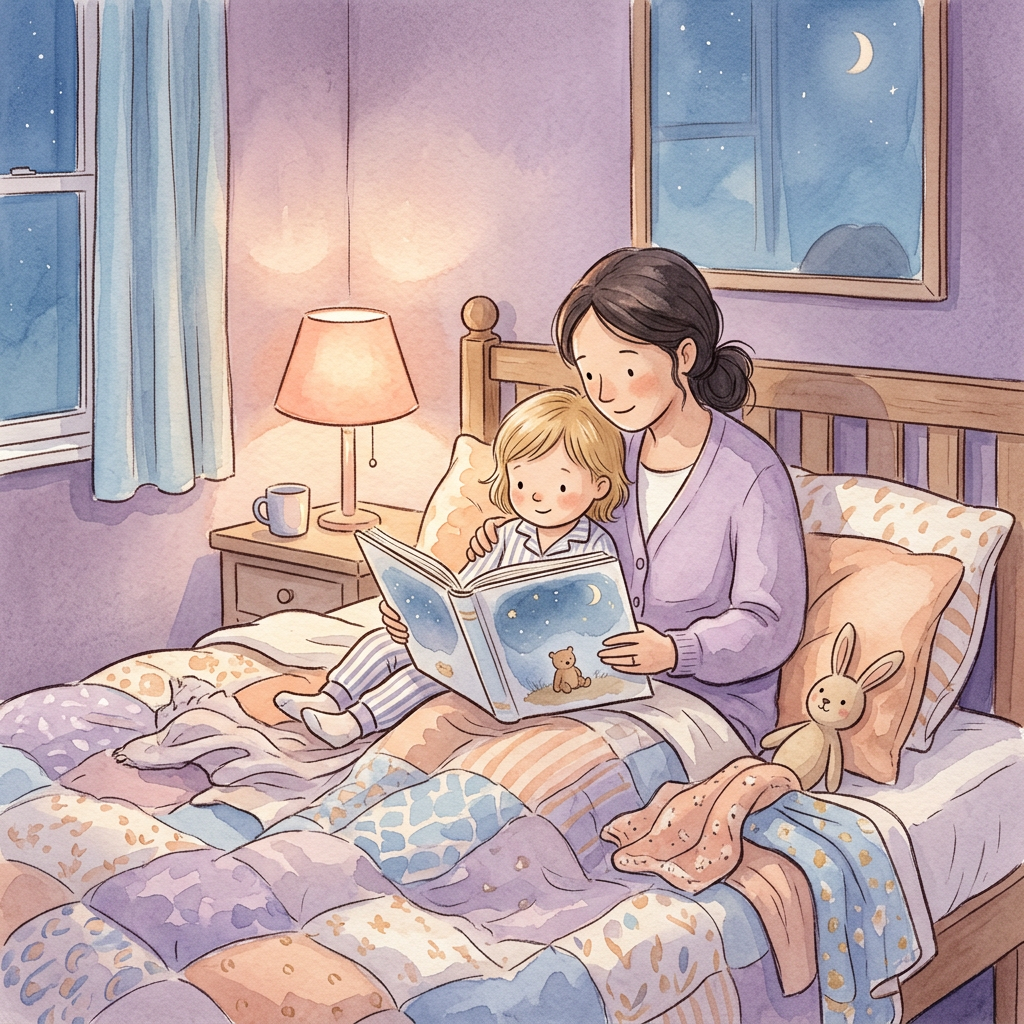
5. A story, told or read, with you sitting still. This is the part that actually gets remembered. Not because the story itself is magic, but because it's the one moment in the whole evening where nothing else is competing for your attention — no phone, no chores, just your voice and their name in the plot if you're using Wispalo, or their favourite characters if you're reading something else.
Why stories work where screens don't
A story does everything a screen does for a tired parent — it's calming, it's reliably enjoyable, your child looks forward to it — without any of the drawbacks. The pace is set by a human voice, not an algorithm optimising for "one more minute." There's no bright light. And because it ends when the story ends rather than when a platform decides to autoplay the next thing, bedtime doesn't turn into a negotiation about turning something off.
It also does something screens generally can't: it gives your child undivided attention at the exact moment they're most receptive to it. Child development researchers have long pointed to the bedtime story as one of the few daily rituals that reliably builds a sense of security before sleep — not because of the plot, but because of the closeness.
If you're too tired to make one up
Some nights you have a story in you. Most nights, honestly, you don't — and that's not a parenting failure, it's just what being exhausted at 7pm looks like. This is exactly the gap Wispalo was built for. You add your child's name, age and interests once, and Wispalo generates a short bedtime story with them as the hero — no screen glow, no scrolling, just something to read or listen to together that took you thirty seconds to create instead of the ten minutes you don't have left.
You're still the one turning the pages, or sitting there while it plays. You just don't have to invent the plot from scratch at the end of a long day. If your wind-down routine has everything else in place and you're stuck on the last five minutes, that's worth trying at wispalo.com.
Try a story tonight
Wispalo turns your child into the hero of their own bedtime story in seconds.
Create a free story