
Why Your Child Wants the Same Bedtime Story Every Night (And When a New One Helps)
Asking for the same bedtime story again and again isn't a phase to fix — it's how young children feel safe and learn language. Here's why repetition helps, and a gentle way to introduce something new when you're ready.
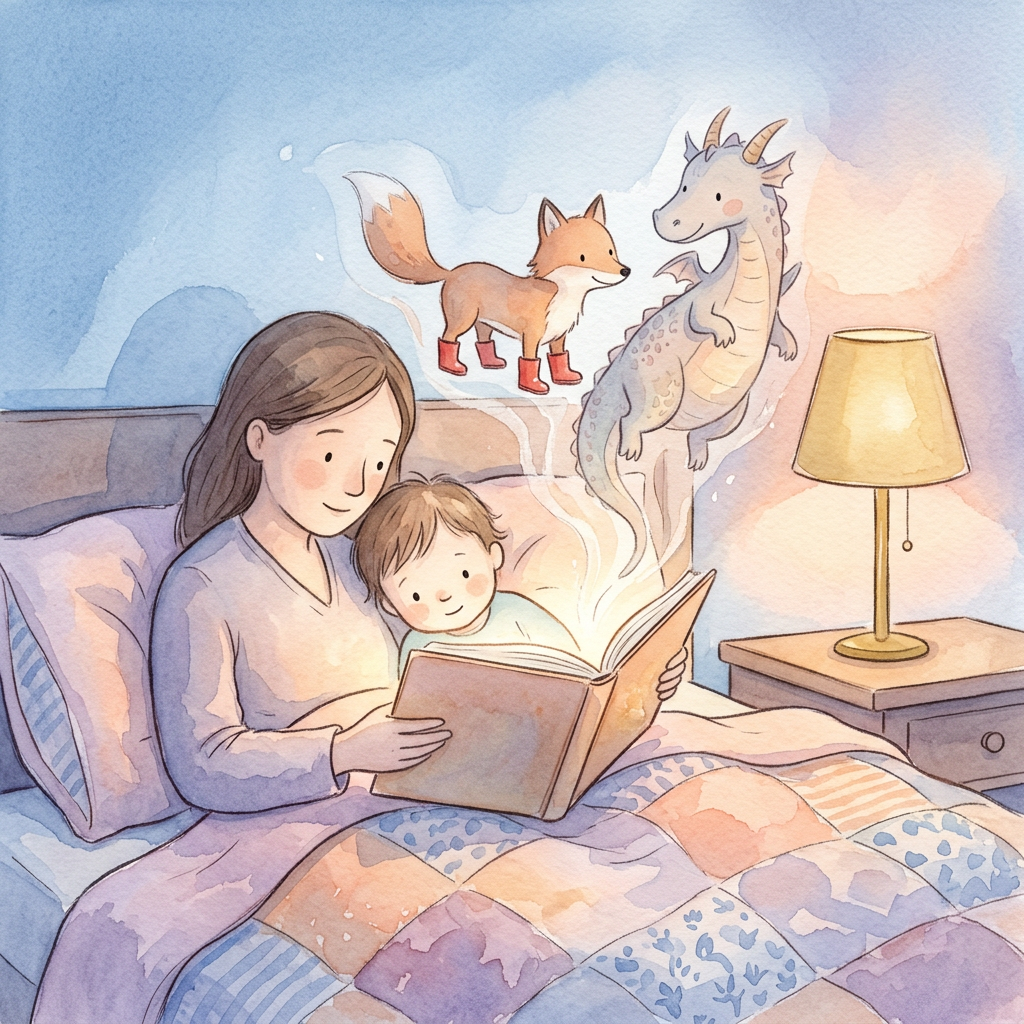
If you have read the same bedtime story four nights running and your child still asks for it a fifth time, you are not imagining it — and you are certainly not alone. "Again! The same one!" is one of the most universal phrases in parenting, right up there with "just five more minutes." It can feel baffling, even a little dispiriting, when you have a shelf full of lovely books and a head full of new ideas, and all your child wants is the one about the fox who loses his wellies. So what is going on, and when, if ever, should you nudge things towards something new?
Why repetition feels so good to a small brain
For young children, the world is enormous and largely unpredictable. They do not know what is coming next at nursery, they cannot always tell if Dad is cross or just tired, and bedtime itself marks the daily disappearance of every grown-up they love for several hours. Against that backdrop, a story they already know is a small island of total certainty. They know the fox finds his wellies. They know the dragon turns out to be friendly. They know, crucially, how the story ends before it has even started — and that predictability is deeply soothing, particularly in the last stretch before sleep, when a developing nervous system is looking for reasons to calm down rather than reasons to stay alert.
There is a cognitive upside too. Developmental researchers have long noted that repetition is how young children consolidate language and narrative structure. The first time through, a lot of their attention goes on simply following what is happening. By the fifth or fifteenth time, they already know the plot, so their attention is free to notice new things: a rhyming phrase, a word they have just learned at school, the way a sentence is put together. Repetition is not your child failing to move on. It is quite often your child doing some genuinely sophisticated learning, just not in a way that looks effortful from the outside.
There is also a simple matter of mastery and control. Bedtime is one of the few points in a small child's day where they get a real say in what happens next, and asking for "the same one, please" is a tiny, safe way of exercising that choice. It is worth remembering this when a request for repetition appears, as it often does, right after a day that felt wobbly or over-scheduled for your child. A familiar story is a way of saying "can we have a bit of normal, please" — even if they would never put it that way themselves.
So is it ever worth introducing something new?
Yes — just not because repetition is a problem. A new story earns its place alongside the old favourite for different reasons entirely: to widen vocabulary, to gently introduce a topic your child is about to face (a new sibling, the first day at nursery, a wobbly tooth), or simply because you, the exhausted adult reading it for the nineteenth time, deserve a bit of variety too. Your own enjoyment matters here. A story read with genuine warmth and a bit of life in your voice will always land better than one read on autopilot, so there is no shame in steering gently towards something fresh when the old one has stopped sparking anything in you.
The trick, most sleep and early-years specialists agree, is not to force the swap but to make the new story irresistible enough that your child chooses it. A story that already has their name in it, with a sibling or a beloved toy woven into the plot and a problem that feels just like their own, tends to get far less resistance than a brand-new book plucked at random off the shelf. Children are remarkably willing to try something new when the something new is, in a very real sense, already about them.
This is one of the quieter reasons families come to Wispalo. Rather than choosing between the comfort of repetition and the benefit of variety, you can create a story that gives your child both: a brand-new adventure each time, built around them, their interests, and whichever theme suits that particular night — a wobbly tooth, a new baby, a trip to the moon — but told in a voice and style that still feels reassuringly like "their" kind of story. For children who are narration fans, the finished story can be read aloud to them by one of several gentle voices, which is a lovely option on the nights you simply cannot do one more read-through yourself.
A gentle way to think about it
If your child wants the same story on repeat, there is nothing to fix. Let it run its course — most children move on in their own time, usually once the story has done its emotional job and a new interest or worry has taken its place. If you do want to introduce something new, do it by making the new option genuinely appealing rather than by retiring the old favourite outright, and do not be surprised if your child wants to alternate between the two for a good while yet.
And on the nights when you would simply like something new, with your child's name woven through it and a cover illustration to match, created in moments rather than chosen from a shelf, that is exactly the gap Wispalo was built to fill. You can try creating a free story at wispalo.com and see whether it earns a place in the bedtime rotation.
Try a story tonight
Wispalo turns your child into the hero of their own bedtime story in seconds.
Create a free story